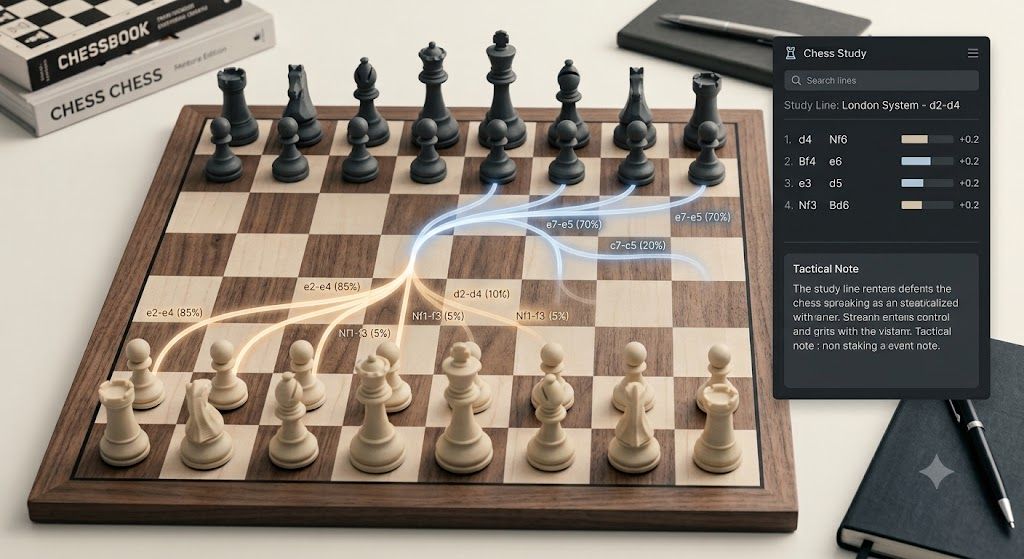
If you want to get better at openings, you do not need a giant theory dump. You need a fast way to ask one question: what usually happens after this move?
That is what a chess opening explorer is for. It lets you step through a line one move at a time, compare common continuations, and see where the opening branch actually starts to matter. Used well, it saves time and helps you build a repertoire from positions you will actually reach.
This page is the opening-explorer hub
Treat this article as the hub for the opening-explorer cluster. It answers broad intent around how to study lines, why the tool matters, and which habits make an explorer practical. When you need adjacent intent, use the supporting pages listed below—each one links back here and keeps the hub’s story intact.
- Chess.com Explorer Alternative — a stripped-down workflow for searchers who landed here via chess.com explorer queries and want the fastest way to compare branches.
- Chess Opening Transpositions — move-order traps, duplicate positions, and how to avoid studying identical lines twice.
- Chess Opening Explorer Use Cases— specific tournament, repertoire, and practice routines built around this hub’s workflow.
- Chess Game Explorer — the bridge between opening theory and the real games that show how a line should feel over the board.
Use the hub to answer intent such as “how do I study opening lines” or “what should I do after move three.” Branch into the supporting pages when you need depth on transpositions, search intent for alternatives, or a use-case workflow to share with teammates.
What an opening explorer does
A good explorer turns opening study into a decision tool, not a memory test.
You can use it to:
- check the most common replies after your first few moves
- compare sharp lines with quieter alternatives
- spot transpositions that lead to the same middlegame
- see which branches are rare enough to treat as sidelines
- identify where your opponents are most likely to go off book
The point is not to memorize every move. The point is to understand which moves matter.
Start with one opening, not all of them
The fastest way to waste time is to bounce between openings.
Pick one line you already play or want to play. For example:
- as White: 1.e4 into an open game
- as Black: one response to 1.e4 and one response to 1.d4
Then use the explorer to answer three questions:
- What is the main move order?
- Which second- and third-move branches appear most often?
- Where do the positions stop being theory and start becoming chess?
If a line is common, study it first. If a line is rare, keep a short note and move on.
What to look for in the explorer
The most useful signals are not the fanciest moves.
Look for:
- frequency: which moves show up most often
- consistency: which moves keep the same pawn structure
- transpositions: different move orders that land in the same position
- practical traps: lines that punish careless development or early tactics
- model games: examples from strong players that show the plans, not just the moves
This is especially useful in open openings where one small tempo can change the whole game. A move that looks equal on move 4 may be much worse on move 6.
How to study a line in 15 minutes
You do not need a two-hour session to get value.
Use this workflow:
- Open the line you want to study.
- Follow the main branch for 5 to 8 moves.
- Check the top alternatives at each branch point.
- Save the move order that feels easiest to remember.
- Look at one or two model games in the same structure.
If you are reviewing after a game, stop at the move where you left theory. That is usually where the most useful learning starts.
Common mistakes
Most players use an explorer badly in one of three ways.
First, they only chase engine-like moves and ignore practical ones. That creates lines they will never remember under time pressure.
Second, they assume the explorer gives one best move in every position. In reality, many openings have several playable branches.
Third, they study opening moves without checking the middlegame plan. If you do not know why the line exists, you will forget it quickly.
A simple rule for better opening prep
If you cannot explain the point of the line in one sentence, you do not know it yet.
For example:
- "This line aims for quick development and a safe king."
- "This branch trades early to reduce tactical risk."
- "This move order avoids an annoying transposition."
That is enough for most practical preparation.
When to use a chess opening explorer again
Use it before a tournament game, after a loss, or any time you face the same opening twice.
It is also useful when you change repertoire. If a line feels hard to remember, check whether there is a simpler move order that reaches the same position with less work.
When to branch into supporting guides
Not every question needs another theory-heavy page. Use the supporting guides when you need a narrow answer:
- Need a faster workflow that mirrors the chess.com explorer experience? Follow the workflow in Chess.com Explorer Alternative and jump back here once you pick a line to study.
- Chasing move-order duplicates? The Chess Opening Transpositions page is all about marking the shared position and pruning redundant study.
- Want a concrete routine for tournaments, repertoire cleanups, or rapid prep? The new Chess Opening Explorer Use Cases page lays out those exact scenarios while keeping the hub’s workflow as the backbone.
- Looking to connect openings to real games? The Chess Game Explorer guide keeps your study tied to model games and practical plans.
Related study pages
This page is the main opening-study entry point.
Use these supporting pages when you want a narrower angle:
- Chess Opening Explorer Alternative for searchers who want a quicker workflow and a simpler move-order review.
- Chess Opening Transpositions for move-order traps, duplicate positions, and transposition-heavy lines.
- Chess Opening Explorer Use Cases for reproducible routines that map directly back to this hub’s workflow.
- Chess Game Explorer for matching the chosen line to real games and the middle-game plans they reveal.
- ScriptChess Openings for the broader opening cluster and repertoire overview.