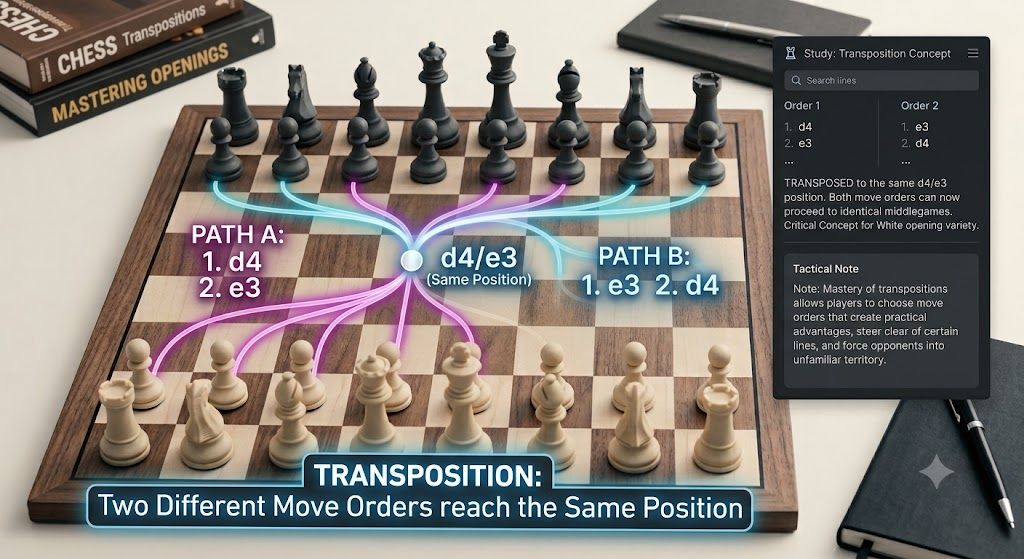
Transpositions are where opening study gets either efficient or repetitive.
If two move orders land in the same position, you should not treat them like separate lines. You should treat them like one idea with two entrances. That saves prep time and makes your notes easier to remember.
How this page fits the cluster
This is a supporting page for the main opening-study pages:
- Free Chess Explorer for move-by-move opening research.
- Chess Opening Explorer: How to Study Openings Move by Move for the broader study workflow.
- ScriptChess Openings for the parent opening cluster.
- Chess Opening Explorer Use Cases for routines that weave transposition awareness into tournament or practice prep.
What a transposition really is
A transposition is not a trick. It is just the same position reached by a different path.
That matters because the position, not the move order, decides the plan.
When you see the same structure through two routes, ask:
- Which move order is easier to remember?
- Which one avoids annoying sidelines?
- Which version fits your time control?
- Which entrance gives the clearest middlegame plan?
Where players waste time
Most players make one of two mistakes.
They either study move order only and miss the shared position, or they memorize both move orders when one is enough.
Both waste time.
The better approach is to write the shared position first, then note the move order only as context.
A simple way to review a transposition
Use this checklist:
- Write the final position after the branch splits.
- Compare the best move order for White and for Black.
- Mark the move that changes the structure.
- Save one model game for the shared position.
- Ignore the duplicate line unless it creates a real practical issue.
That keeps your repertoire compact.
What to watch for
The most common transposition signals are:
- early knight development that leads to the same center
- pawn moves that can be played in two orders
- fianchetto setups that repeat across openings
- queen exchanges that simplify the same structure from different paths
If the position is the same, the plan is usually the same too.
Why this matters for search intent
People searching for transpositions usually do not want a theory dump.
They want to know whether two lines are actually different, which one is easier to play, and how to avoid learning the same thing twice.
That is why this page supports the main opening explorer instead of replacing it.
The same clarity that keeps duplicate branches out of your notes is also what the Chess Opening Explorer Use Cases page leans on before it hands you a ready-made study routine.
Bottom line
If you study openings through transpositions, you stop collecting duplicate lines and start collecting useful positions.
That is the real payoff: less memorization, cleaner notes, and faster recall when the game starts to drift.
Use this supporting guide as you prune your notes, then return to the Chess Opening Explorer hub to pick the next line or to load one of the supporting workflows.