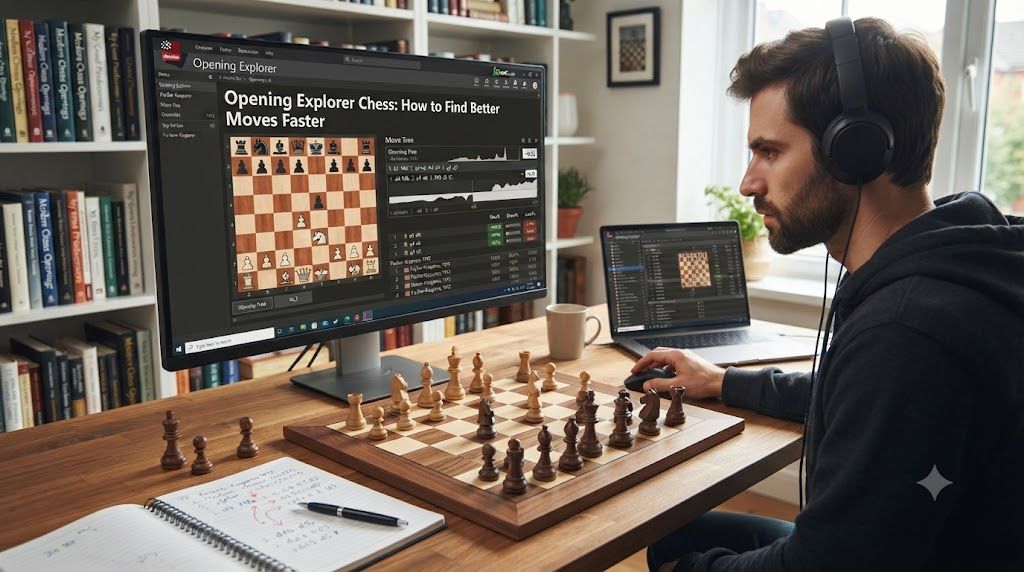
Opening explorer chess is one of the fastest ways to improve your opening study without drowning in theory. Instead of memorizing random move orders, you compare real positions, see what stronger players choose, and learn which plans actually matter.
That matters because most players do not lose in the opening to one bad move alone. They lose because they never understood the structure, the pawn breaks, or the plans behind the moves. An opening explorer helps you stop guessing.
What an opening explorer actually does
At its best, an opening explorer shows you how a position has been played in real games. You can see common moves, result trends, and the positions that appear again and again. That gives you context before you spend time on deeper analysis.
Use it to answer simple questions:
• What do strong players usually play here?
• Which lines lead to the kinds of middlegames I like?
• Where do games branch into different plans?
• Which moves are popular because they are practical, not just theoretical?
If you want a place to test those ideas after exploring the opening tree, pair this study with our free chess engine and our chess openings explorer.
Why opening study gets messy without a tool
Manual opening study often turns into note-hoarding. You save lines, copy engine output, and never connect the dots between move order and plan. That is why many players know a line on paper but still feel lost over the board.
An opening explorer fixes three common problems:
• It shows you what is actually played, not just what a database thinks is good.
• It keeps your study centered on positions, not just memorized notation.
• It helps you notice recurring patterns across multiple openings.
That is especially useful if you are comparing openings from beginner-friendly systems like the London or Italian to sharper choices like the Sicilian or King’s Indian. We cover some of those practical choices in The Top 10 Most Popular Chess Openings for Beginners.
How to use opening explorer chess well
Start with one position, not one full opening tree. Pick the line you actually reach in your games, then ask what the next practical decisions are.
Use this sequence:
• Enter the position from a real game you played.
• Check the most common continuations.
• Compare the ideas behind the top moves.
• Look for where the position changes character.
• Save only the lines that support a clear plan.
That approach helps you build a repertoire instead of collecting trivia. If you want to move from study to practice, open Chess Openings Explorer & Deep Theory Database and work one branch at a time.
What to look for beyond move order
The best opening explorers do more than list moves. They reveal the themes that decide whether a line suits your style.
Pay attention to:
• king safety
• pawn structure
• central tension
• piece activity
• whether the position stays tactical or simplifies quickly
If you like attacking play, you may prefer openings that keep the initiative. If you prefer stability, you may want quieter structures where you can outplay people later. The explorer helps you see that difference before you commit to a line.
Common mistakes to avoid
Do not treat the top move as the only move. Popular does not always mean best for your style.
Do not ignore your own results. If a move scores well in databases but you never understand the resulting middlegame, it is still a bad fit.
Do not stop at the first branch. The point of opening explorer chess is to understand why the position changes, not just which move is first in the tree.
Build a routine that sticks
A good weekly routine is enough:
• Review one opening position from your last game.
• Compare two candidate moves.
• Check a few model games.
• Finish with engine verification.
That is enough to make your opening study cumulative instead of random. Over time, you start recognizing structures instead of memorizing lines.
Ready to explore?
Ready to explore? Use our free chess opening explorer at Study Openings and turn your opening study into a repeatable process.