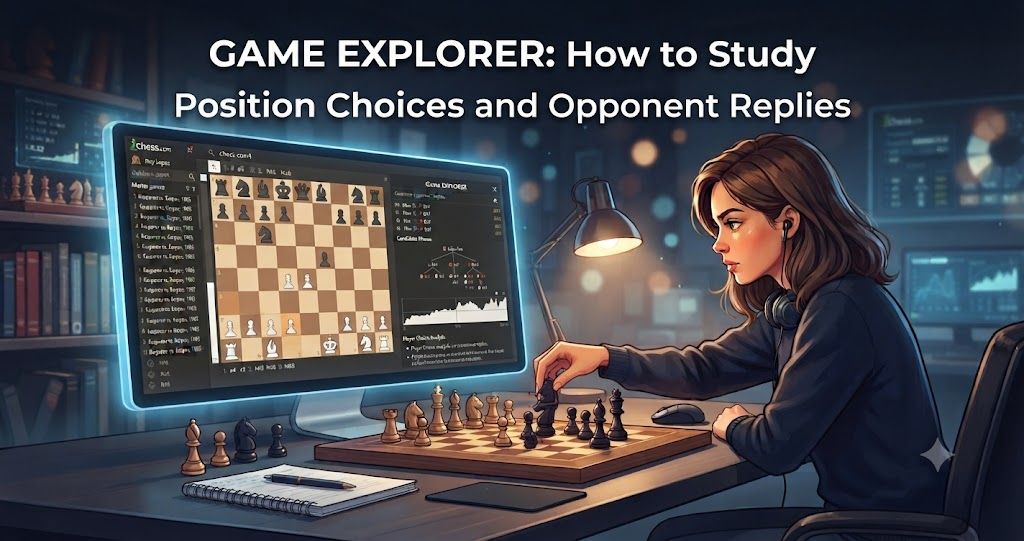
Game Explorer is the tool you use when you want to know what actually happens after a position appears on the board. It is not just about moves. It is about the replies opponents choose, the results those replies produce, and the plans that follow.
That makes it different from an opening explorer. Opening study teaches the structure of a line. Game Explorer teaches you how to prepare for the branches your opponent is most likely to pick.
What Game Explorer is for
Use Game Explorer when you want to answer practical questions:
- What moves are actually played in this position?
- Which replies score well?
- Where do players usually deviate?
- What kind of middlegame comes next?
If you want the same workflow on the opening side, use Study Openings. If you want the position-and-replies view, use Game Explorer.
Why this is not the same as opening study
Opening study is about learning a line well enough to survive the start of the game. Game Explorer is about learning what your opponent can choose after the opening begins to branch.
That matters because two positions can look similar and still lead to very different plans. Game Explorer helps you see those branches before they surprise you over the board.
What to look at first
Start with the position, then check:
- The most common moves.
- The best-scoring replies.
- The positions that repeat most often.
- The plans that follow each branch.
That is enough to turn raw move data into something usable.
How to build a repertoire with it
Game Explorer is useful for repertoire prep because it shows you what your opponent is likely to choose. That lets you prepare branches instead of memorizing a single path.
Use it to decide:
- which reply lines need more work
- where you can simplify your study
- which structures fit your style
- when to spend time on engine checks
For deeper move-by-move checking, combine this with Free Chess Engine.
Common mistakes
Do not treat the first branch as the whole story.
Do not study move order without looking at the resulting position.
Do not assume the most popular move is automatically best for your style.
The value is in comparing choices, not collecting them.
A simple weekly routine
Each week, pick one position from a recent game and do this:
- review the common replies
- check the result stats
- write one sentence about the plan behind each branch
- save one branch to your repertoire notes
That keeps your study focused and stops the tool from becoming just another move database.
Ready to explore?
Ready to explore? Use our free chess opening explorer at Study Free Chess Explorer and turn position study into a repeatable habit.