Chess game explorer study gets more useful when you tie it to a real event field instead of random database lines. The announcement of Speed Chess Championship XI is a perfect example. Chess.com has set up a huge, high-stakes field for one of the most watched online events in the world, and the roster alone tells you what kinds of positions are worth studying if you want to get better at fast chess. If you are trying to turn event news into actual improvement, this is the right kind of story to watch.
Context: What Happened
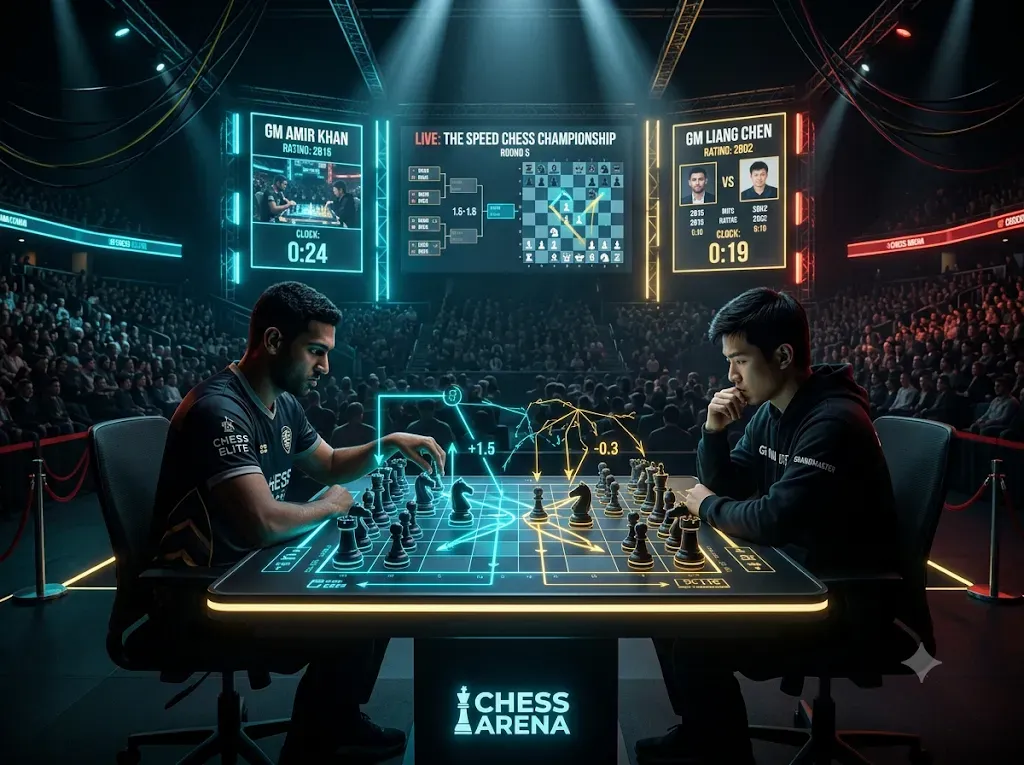
On Nov. 3, 2026, Chess.com announced Speed Chess Championship XI, a 10-year anniversary edition of one of the site’s flagship events. The prize fund is $250,000, the event starts in November, and the live finals are scheduled for London, England, on Feb. 5 to 7, 2027 at 180 Studios. The format is familiar but brutally effective: sixteen of the world’s best players will play knockout matches that include blitz and bullet sections, and the tournament also feeds into the broader Champions Chess Tour and the race for Esports World Cup qualification.
The field is a headline by itself. Magnus Carlsen and Hikaru Nakamura are both back, as are Alireza Firouzja, Denis Lazavik, Javokhir Sindarov, Praggnanandhaa Rameshbabu, Nihal Sarin, Nodirbek Abdusattorov, Hans Niemann, Dmitry Andreikin, Wesley So, and several other top players. That mix tells you a lot about the modern speed-chess ecosystem. You are not just looking at one style or one opening family. You are looking at a clash of preparation systems, time-management skill, tactical instinct, and the ability to recover instantly after a bad move.
The same event article points out that the championship has evolved from an experimental online showdown into an esports-style spectacle over the last decade. That history matters because online speed chess is no longer a side show. It is a serious proving ground. The players who succeed here tend to be excellent at selecting opening structures they understand deeply and then converting that understanding under extreme clock pressure.
Why This Matters for You
This is exactly the kind of event where a chess game explorer pays off. When strong players prepare for speed chess, they are not looking for every possible move in a line. They are looking for positions they can recognize instantly. They want lines that let them play fast without giving away the game on move 8.
That is a useful model for everyone else. Most club players lose time, not because they are incapable of seeing the right move, but because they spend too long deciding whether the position is familiar. If you use a chess game explorer well, you can reduce that hesitation. You see the opening structure, the key tactical patterns, and the transitions that the elite players keep choosing. That makes your own decisions faster.
The Speed Chess Championship field also shows how much style matters. Carlsen may prefer one kind of position, Nakamura another, Firouzja another. If you study their games only as isolated tactics, you miss the bigger lesson. Their success comes from matching the opening to the time control and the opponent. That is the real practical skill. Good speed-chess players do not just know theory. They know which positions feel natural when the clock gets ugly.
So if you want your study to translate into results, the question is not "What is the best move?" It is "What kind of positions do strong speed players keep steering toward, and how do I get those positions in my own games?"
Key Takeaways
• Speed chess rewards recognition, not just calculation.
• Event fields reveal which styles and opening structures are still viable at the highest level.
• A good explorer session should help you choose practical positions, not memorize more moves.
• The best speed-chess repertoire is one you can play quickly and confidently.
How to Practice This
Start with the field. Pick two or three players from the Speed Chess Championship XI roster and study how they open their games in blitz and bullet. Carlsen and Nakamura are the obvious names, but players like Firouzja, Lazavik, Sindarov, and Praggnanandhaa are just as useful if you want a younger, more tactical perspective. Your goal is not to copy their exact repertoire. Your goal is to see what kinds of structures recur and why they are comfortable.
Use this process with our Free Chess Explorer:
• Search your own main opening or a top player’s opening.
• Watch the first critical branch, not just the first move.
• Note where the position becomes tactical, symmetrical, or structurally locked.
• Save the move orders that lead to positions you can play quickly.
• Replay a few model games and try to explain each transition in one sentence.
Then use opening explorer to compare adjacent choices. In fast chess, the difference between two move orders may be small on paper and huge in practice. One order may allow a comfortable development scheme. Another may drag you into a line you only half-remember. That is exactly the kind of issue a chess game explorer helps you find.
For speed-chess prep, the best practice block is short and repeatable. Review one opening family, one tactical motif, and one endgame transition. Then play a few rapid or blitz games with that specific structure in mind. If you consistently reach positions you have already seen, you will think faster. That is the whole game.
You can also build a simple "first 10 moves" file for each main opening. Write down the positions you most want to reach, the traps you most need to avoid, and the one tactical idea that keeps showing up. That turns abstract event coverage into a practical study system. When the clock is ticking, that kind of organization matters more than a huge database.
Related Resources
Use Opening Explorer when you want to compare move-order choices, and use Game Explorer when you want to see which positions the field actually produces. Add tactical reinforcement with master mode chess puzzles , especially if your speed games often collapse in one mistake.
If you want a fuller review loop, revisit Endgame Trainer for the moments when the opening worked but the conversion still matters. The point of a chess game explorer is not simply to browse games. It is to spot the repeatable shapes that let strong players move quickly without losing control.
Conclusion
The Speed Chess Championship XI announcement is more than a calendar item. It is a snapshot of what elite online chess looks like right now: fast, sharp, deeply prepared, and heavily dependent on positions that can be understood at a glance. That is why chess game explorer study matters. It helps you choose the positions that fit your time control, your style, and your practical chances.