Chess explorer study is usually about finding the best move in a familiar opening. Crazyhouse changes that. One capture can instantly become a new attacking resource, and one mistake can turn into a forced mate. That is why Janak Awatramani's second Crazyhouse Championship title matters beyond the variant itself. It shows how quickly initiative, pattern recognition, and board awareness can decide a game when the position is unstable.
Context: What Happened
On Nov. 7, 2026, Chess.com reported that NM Janak Awatramani won the 2026 Crazyhouse Championship, beating GM Guillermo Vazquez 3-0 in the Grand Final. The win followed his earlier championship in 2024, making him a two-time titleholder in one of Chess.com's most chaotic community events. Awatramani also has a strong track record in Bughouse-style events, which fits the profile of a player who thrives when the position becomes tactical, compressed, and unpredictable.
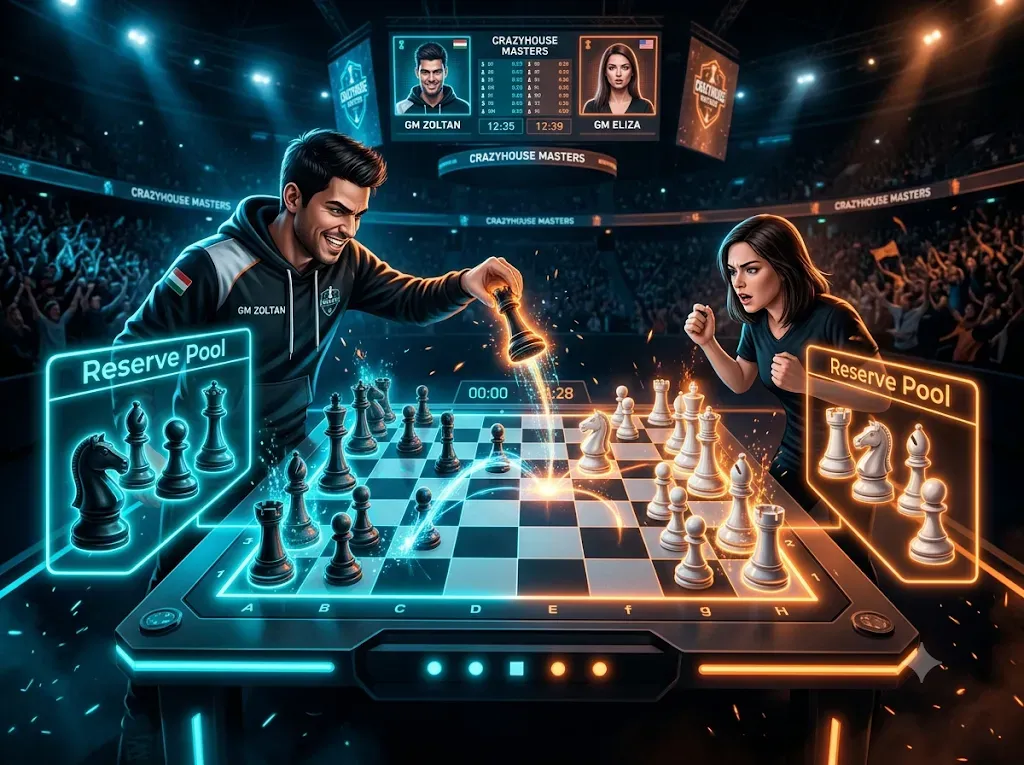
The event itself was a good reminder that crazyhouse is not normal chess with a weird add-on. It is its own ecosystem. Captured pieces go into your pool and can be dropped back onto empty squares on your turn. That means the game can transform in a single tempo: a piece that was off the board a moment ago can suddenly become a checking piece, a mating net, or a defensive resource. The article on Chess.com even points out that crazyhouse is often called "Bughouse for one player," which is a neat shorthand for how explosively the position can change.
The championship format reinforced that idea. Players first fought through eight qualifying arenas, then entered an eight-player double-elimination final. Awatramani handled the bracket with authority. He beat Isaac Chiu, the defending champion, in the winners final 3-1 before sweeping Vazquez in the grand final. The final result was decisive, but the route there was full of swingy positions, bullet tiebreaks, and games where the player who understood the dropped-piece resources a little better came out on top.
Why This Matters for You
A lot of players treat variant chess as entertainment only. That is a mistake. Chess explorer study becomes more valuable when you use unusual formats to train the same core skills you need in standard chess: pattern recognition, king safety, tactical alertness, and evaluation under pressure.
Crazyhouse magnifies those skills. Because pieces can return to the board, you have to think about attacks in a wider way. A captured knight is not just a point score; it may become a drop on f7, h7, or e6 one move later. A rook sacrifice may not be a sacrifice at all if the opponent can immediately bring another piece into play. That forces you to scan the board differently. You stop asking only "What move wins material?" and start asking "What move changes the attack budget?"
That mindset transfers well to regular chess. In normal games, initiative is also a resource. You may not get to drop pieces, but you do get to create threats, force concessions, and keep your opponent from reorganizing. Players who study crazyhouse often become more alert to tactical patterns because they spend so much time tracking checks, mates, and recaptures. They also get better at seeing when a position is about to explode.
So even if you never play crazyhouse seriously, there is value in studying it through a chess explorer. The tool helps you understand how positions become tactical, not just how opening theory starts.
Key Takeaways
• Crazyhouse turns every capture into a potential future threat.
• Initiative matters more than static material in many variant positions.
• A strong tactical eye is often more useful than long-term positional plans in chaotic formats.
• Variant study can improve your board vision in standard chess too.