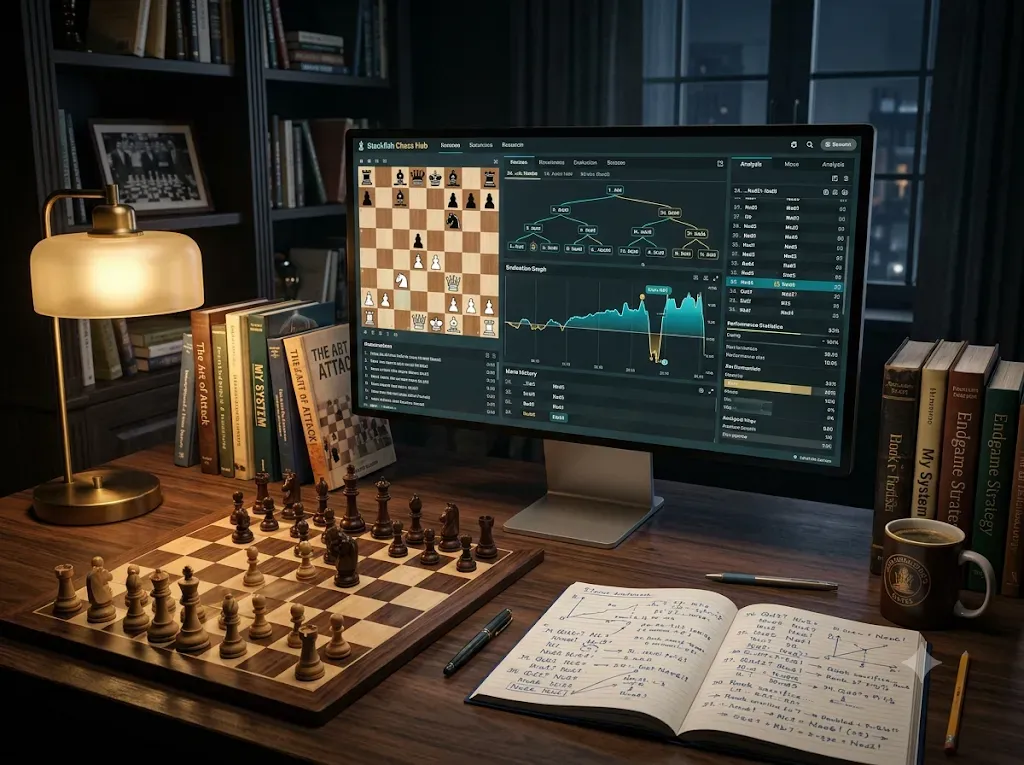
If you have been looking for a chess explorer that does more than replay moves, the useful question is not just what the board shows. The real value is what it helps you learn: which plans repeat, which structures appear across master games, and which lines are worth adding to your repertoire. A good explorer is a research tool first and a convenience tool second. It lets you move from one model game to the next, compare branches quickly, and stop memorizing random theory without context.
That matters because many players use an opening page only to find a move order. Useful, yes, but incomplete. The better workflow is to use the explorer to study full games, identify recurring themes, and then decide what belongs in your own system. In other words, you are not just collecting moves. You are building a decision tree based on evidence. That is how you get stronger with less guesswork.
What a chess explorer is really for
At its best, a chess explorer is a map of practical chess knowledge. It shows games, lines, move orders, and transpositions in a way that is faster to scan than a raw PGN file and more flexible than a static article. When you open a position in game explorer, you are not only checking the next move. You are checking how often a move appears, what stronger players chose, and what happened later in the game.
That makes the explorer useful for three tasks at once:
• Spotting common responses in a position.
• Comparing candidate lines side by side.
• Checking whether a line leads to positions you actually want to play.
The key is to treat the explorer as a filter. It helps you narrow the field before you spend time on deeper study. If a move appears in many master games and leads to the kind of middlegame you understand, it deserves attention. If a move is trendy but creates structures you hate, it may be more noise than opportunity.
Start with master games, not with move memorization
The fastest way to waste study time is to begin with a line you found on a random engine line and try to memorize it move by move. That approach breaks down as soon as an opponent deviates. Master games give you a better base because they show the line in context. They tell you how the opening connects to the middlegame, which plans follow naturally, and where the typical tactical moments arrive.
When you use the explorer, look for games that meet three conditions:
• The players are strong enough to matter for your level.
• The game reaches a structure you are likely to see again.
• The middlegame plans are clear enough to explain in one sentence.
Once you find those games, study them in batches. Compare a win, a draw, and a loss in the same structure. Do not stop at the first result that looks promising. A repertoire line is only useful if you understand its practical range. The same opening can lead to sharp attacks, quiet endgames, or messy imbalances depending on one small move order detail.
This is where search games becomes valuable. Use it to find examples that match your structure, your rating band, or the exact pawn skeleton you want to study. Then return to the explorer and compare them with the main line.
Compare lines by plans, not only by engine score
Engine evaluation is useful, but it should not be the only thing you look at. A line that scores well may still be awkward for you if it asks for precise defense, unnatural king placement, or long forced calculation. A slightly quieter line may be better if it gives you stable plans and familiar endgames.
When comparing two candidate lines in the chess explorer, ask these questions:
• What are the first strategic differences after the opening moves?
• Which side gets the easier development?
• Where does each side usually place the pieces?
• What pawn breaks matter most?
• Is the resulting position tactical, positional, or endgame-heavy?
This kind of comparison keeps you from choosing a move only because it is fashionable. You are not trying to be the engine. You are trying to build a practical repertoire that you can remember and execute under time pressure.
If you want to go one step deeper, use the explain position button after you identify the critical tabiya. The explorer helps you find the position. The explainer helps you understand what the position demands.
Build a repertoire from the positions you trust
Once you know which lines you like, turn the explorer research into a repertoire file. That process is simple, but it should be deliberate. Do not save every line you see. Save only the branches that satisfy at least one of these conditions:
• They are common and reliable.
• They lead to structures you already understand.
• They create an imbalance that suits your style.
• They help you avoid bad endgames or problem structures.
For example, if you play Black and you find a master-game line that regularly leads to a setup you know well, that is a strong candidate. If White gets the space advantage but the structure remains stable, that may also be a useful repertoire choice. The point is not to choose the sharpest line. The point is to choose the line that best fits your own strengths.
Use collections to organize the games you want to revisit. Group them by structure, by opening family, or by theme. A clean collection turns your research into a repeatable study system. Without that structure, your best ideas get buried under the next search session.
Keep the explorer and the opening page separate
One reason this topic is worth its own article is that a chess explorer is not the same thing as an opening reference page. An opening page is usually the fastest way to answer a direct question: what is the name of this line, what moves come next, and how do I get to the main branch. The explorer does something broader. It helps you compare actual games, find transpositions, and decide whether the move order deserves a place in your repertoire.
That distinction matters for SEO and for study. If you use the same page to solve every question, the content becomes crowded and the user intent gets muddy. The opening page should stay focused on move-order discovery. The explorer page should stay focused on game context, comparisons, and practical learning. Keeping those jobs separate makes both pages stronger.
In practice, that means using the explorer for discovery and the opening workspace for execution. Once you know the line you want to play, move into study openings to confirm the route, rehearse the key branches, and make the line usable in real games. The explorer tells you what is worth learning. The opening tool helps you lock it in.
A practical study workflow you can repeat every week
You do not need a huge study block to get value from the explorer. A short, disciplined workflow is often better. Try this sequence:
• Pick one opening family or one key position.
• Search for master games in the explorer.
• Choose three games with different outcomes.
• Compare the main branch and one sideline in each game.
• Write down the recurring plans.
• Save the line if it fits your repertoire goals.
• Test the line later in a practice game or review session.
That workflow keeps the study practical. It also prevents the common mistake of collecting too many notes and not enough decisions. If a line comes up repeatedly but always leads to positions you dislike, drop it. If a line looks less popular but consistently gives you a comfortable structure, promote it.
This is also where multiple game analysis can help. Once you have a small set of candidate games, compare them together and look for the exact move where the plans diverge. That is usually the point where a repertoire choice becomes obvious.
The value of the chess explorer is decision quality
The best reason to use a chess explorer is not that it saves time, although it does. It improves the quality of your decisions. You see more examples before committing to a line. You compare more plans before choosing a structure. You separate what is fashionable from what is playable. And over time, you build a repertoire that reflects your understanding rather than someone else’s preference list.
That is the long-term advantage. Strong players do not just know more moves. They know which positions they want, which transitions they trust, and which master games prove the point. The explorer helps you build that judgment one branch at a time.
If you want a simple next step, open the explorer, pick one position, and compare three master games. Then move that choice into your study workflow.
Ready to explore? Use our free chess opening explorer at study openings.