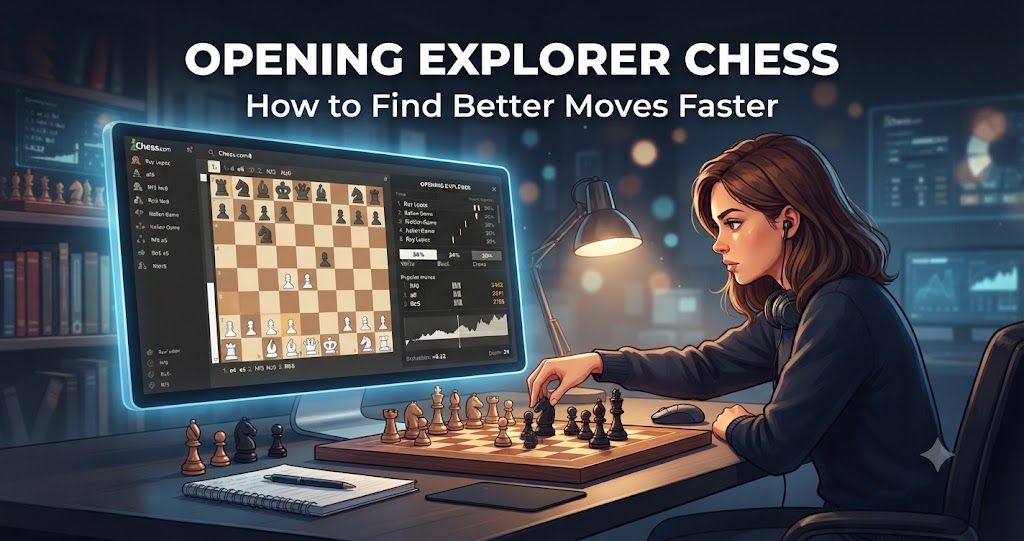
A chess explorer is most useful when it turns opening study into decision-making. Instead of asking, "What is the exact move order?" you ask, "What position am I trying to reach, and why?" That shift makes opening work easier to remember and more useful in real games.
If you want the short version: use a chess explorer to compare positions, test plans, and choose openings that match the way you like to play.
Why a chess explorer is better than memorizing lines
Memorizing opening lines can feel productive, but it breaks down quickly when your opponent deviates. A chess explorer keeps you anchored to positions and themes.
That matters because the opening is not a quiz. It is the first stage of a plan.
When you study with a chess explorer, you can:
- see which positions appear most often
- compare candidate moves in context
- learn whether a line is tactical, strategic, or defensive
- identify where your repertoire needs clarity
If you want to test those ideas in a deeper position tool, pair this with our free chess engine. For a broader study workflow, use Study Openings.
What makes a good chess explorer
Not all tools are equally useful. The best chess explorer gives you three things:
- A clean move tree.
- Real-game context.
- Enough structure to compare plans quickly.
If it only dumps moves on the screen, you still have to do all the thinking yourself. A better tool helps you understand the branches that matter.
In practice, that means you should look for:
- common moves in the position
- response ideas after each major branch
- examples from model games
- quick access to deeper analysis when needed
How to study an opening with a chess explorer
Use a simple workflow.
First, pick a position from one of your games. Do not start from an abstract opening name if you never reach it.
Second, identify the move that makes the biggest strategic difference.
Third, compare the top two or three choices and ask what they change:
- center control
- king safety
- piece activity
- pawn breaks
Fourth, review a few games from stronger players who reached the same structure.
Fifth, confirm the line with engine analysis.
That process is much more durable than drilling the same move order repeatedly. It also helps you make sense of beginner-friendly guides like The Top 10 Most Popular Chess Openings for Beginners.
How this helps different types of players
A chess explorer is useful whether you are trying to survive the opening or build a sharper repertoire.
- Beginners get clarity on what each move is trying to do.
- Club players can fix weak move orders and bad transpositions.
- Advanced players can compare niche branches and choose lines with the right practical risk.
If you prefer quiet positions, you can use the explorer to steer toward stable structures. If you like initiative, you can look for branches that keep tension and create tactical chances.
Mistakes to avoid
Do not treat the explorer as a substitute for understanding.
Do not chase novelty for its own sake.
Do not copy lines from strong players without checking whether the resulting middlegame fits your style.
The point is not to collect move sequences. The point is to know what kinds of positions you are reaching and what plans belong there.
A simple weekly routine
Try this once a week:
- Pick one opening position from a recent game.
- Compare the main branches in a chess explorer.
- Add one note about the strategic goal of each branch.
- Verify the best line with an engine.
- Save the result in your personal repertoire.
That keeps your study focused and prevents opening work from turning into random browsing.
Ready to explore?
Ready to explore? Use our free chess opening explorer at Study Openings and turn openings into a repeatable study habit and our Free chess explorer to prepare a long repertoire.