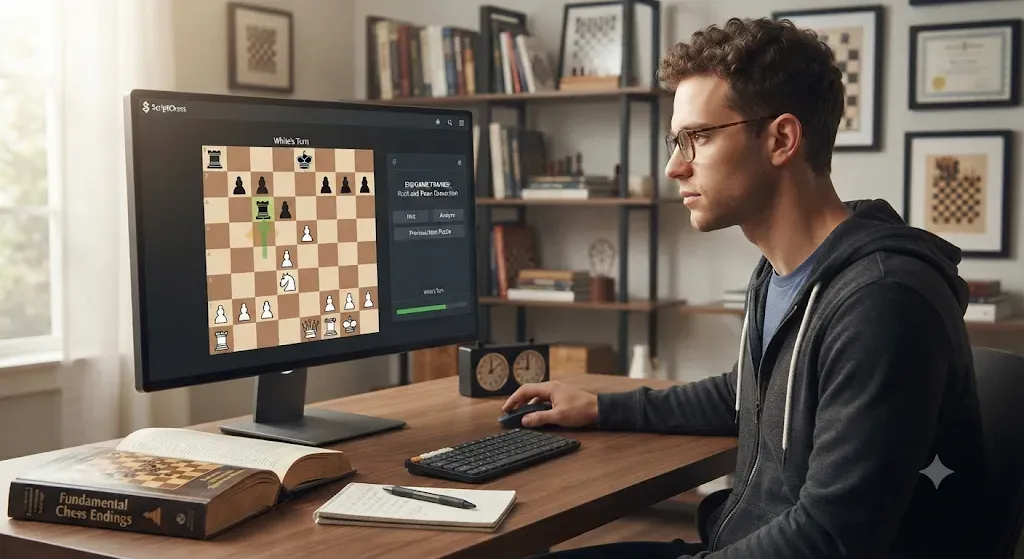
gives you that next step with structured practice, review tools, and study paths that support improvement across the whole game.
You do not need a dozen disconnected tabs to get stronger. You need a trainer, a way to review mistakes, and a place to keep your study moving forward.
What people usually want from a chess.com endgame trainer
The phrase chess.com endgame trainer usually means more than a single feature. Most players are really asking for one of four things:
- a way to practice common endgame patterns
- a way to test whether they can convert a simple advantage
- a way to defend worse positions without collapsing
- a way to see progress instead of guessing at it
That is why endgame training matters so much. Endgames reward precision, but they also reward repetition. The same rook endgame idea, king-and-pawn race, or technical conversion shows up again and again. The player who has seen those ideas before usually makes fewer panicked decisions.
The problem is that many training tools stop at exposure. They show you a position, ask for a move, and move on. That helps a little, but it does not always build habits. Real improvement needs a loop: practice, correction, review, repeat.
If you want that loop inside ScriptChess, start with Study Endgame Trainer. If you want a broader study path after that session, keep Study Training open too.
What a good endgame trainer should actually do
A good endgame trainer should not just hand you positions. It should help you think in patterns.
The best tools give you three things at once:
- A position that feels realistic.
- A clear task that forces a decision.
- Feedback that explains why the move worked or failed.
That matters because endgames are not only about calculation. They are about technique. In one position you may need king activity. In another, you may need to create a passed pawn. In another, you may need to trade into a known winning setup instead of chasing material.
Without feedback, it is easy to repeat the same mistake. You can feel like you are doing endgame work while actually rehearsing bad habits. A useful trainer should help you notice those habits quickly.
ScriptChess supports that approach by connecting practice to review. After you work through a position, you can move into analysis with Free Chess Engine to test the line, then use Free Chess Explorer to understand how the position arose from earlier play.
That combination is more useful than a bare drill set. It lets you see the move, the idea behind it, and the path that led there.
Why ScriptChess is a strong next step
If your search starts with chess.com endgame trainer, your real goal is probably broader than one page or one feature. You want a reliable training system.
ScriptChess is built for that kind of workflow. Instead of treating endgames as isolated puzzles, it helps you connect them to study habits that hold up over time. That is useful because endgame progress depends on consistency more than flash.
Here is where that matters most:
- You can study positions in a structured way instead of browsing randomly.
- You can review your own choices after the fact.
- You can move from one theme to the next without losing context.
- You can connect endgame practice to openings, conversion, and general decision-making.
That last point is underrated. A lot of endgame mistakes start earlier. A poor opening choice can leave you with a worse structure. A sloppy middlegame decision can create a position that is technically drawable but practically miserable. Training that ignores those links can still help, but it leaves value on the table.
That is why ScriptChess also points you toward Study Openings. Strong endgame play is easier when the positions you reach are already easier to handle.
A simple practice routine that actually builds skill
The best endgame routine is not the longest one. It is the one you can repeat.
Try this structure:
- Pick one endgame theme.
- Solve a small set of positions.
- Write down the idea behind each move.
- Check the line with an engine or review tool.
- Repeat the same theme later under a little more pressure.
That routine works because it forces you to remember the idea, not just the move. If you solved a king-and-pawn race, the important thing is not just the final move. It is whether you understood opposition, triangulation, and king activity well enough to recognize the pattern later.
If you want to make that loop more concrete, use Free Chess Engine after the practice set and then compare your choices in Free Chess Explorer. The first tool helps you verify the move. The second helps you understand the structure behind it.
You do not need to study everything at once. Pick one theme per week:
- rook endings
- king and pawn endings
- minor-piece endings
- converting extra material
- defending difficult positions
That pace is slow enough to stick and fast enough to show progress.
How to make endgame work part of a larger improvement plan
Endgame training works best when it is not the only thing you do.
Players often improve faster when they connect endgames to the rest of their study. That way, the same ideas show up in more than one context. You see how a weak pawn structure affects the ending. You see how an active king matters in the transition. You see why simplification can help one player and hurt another.
ScriptChess is useful here because it gives you multiple entry points into study. If you want to start with openings, use Study Openings. If you want to inspect positions in more detail, use Study Free Chess Explorer. If you want direct move verification, use Free Chess Engine. And if you want to keep the whole process organized, Study Training gives you a broader place to build habits.
That matters because improvement is usually a sequence, not a shortcut.
- openings shape the position
- middlegames shape the plans
- endgames test the conversion
If one of those stages is weak, the others eventually feel harder. Training them together gives you a more complete game.
Common mistakes when choosing an endgame trainer
The biggest mistake is assuming any trainer is good enough.
Some tools give you positions without context. Others give you context without repetition. A few make the interface so busy that you spend more time navigating than learning. Those tools can still be useful, but they are not ideal if your goal is steady progress.
Watch out for these mistakes:
- practicing only the positions you already understand
- skipping review after a failed attempt
- treating engine checks as the entire lesson
- moving on before the pattern feels familiar
- ignoring the opening and middlegame decisions that create the endgame
Another common mistake is trying to study too many themes at once. That usually makes the work feel productive while reducing retention. Endgame knowledge compounds when you revisit the same structures enough times to recognize them instantly.
That is why a small, repeatable cycle beats an ambitious but chaotic one.
The practical takeaway
If you searched for chess.com endgame trainer, you are already pointing in the right direction. You know that endgame work matters and that structured practice is better than random browsing.
The next step is to use a workflow that turns practice into progress. ScriptChess can help with that by giving you a better study loop: train a position, verify it, review it, and then connect it to the rest of the game. That is a more durable path than collecting isolated lessons.
Start with Study Endgame Trainer if you want focused practice. Use Free Chess Engine to verify ideas. Use Free Chess Explorer to understand the positions behind the positions. And when you want to broaden the work, bring it back to Study Openings so the whole game starts to fit together.
Ready to explore? Use our free chess opening explorer at Study Openings.